
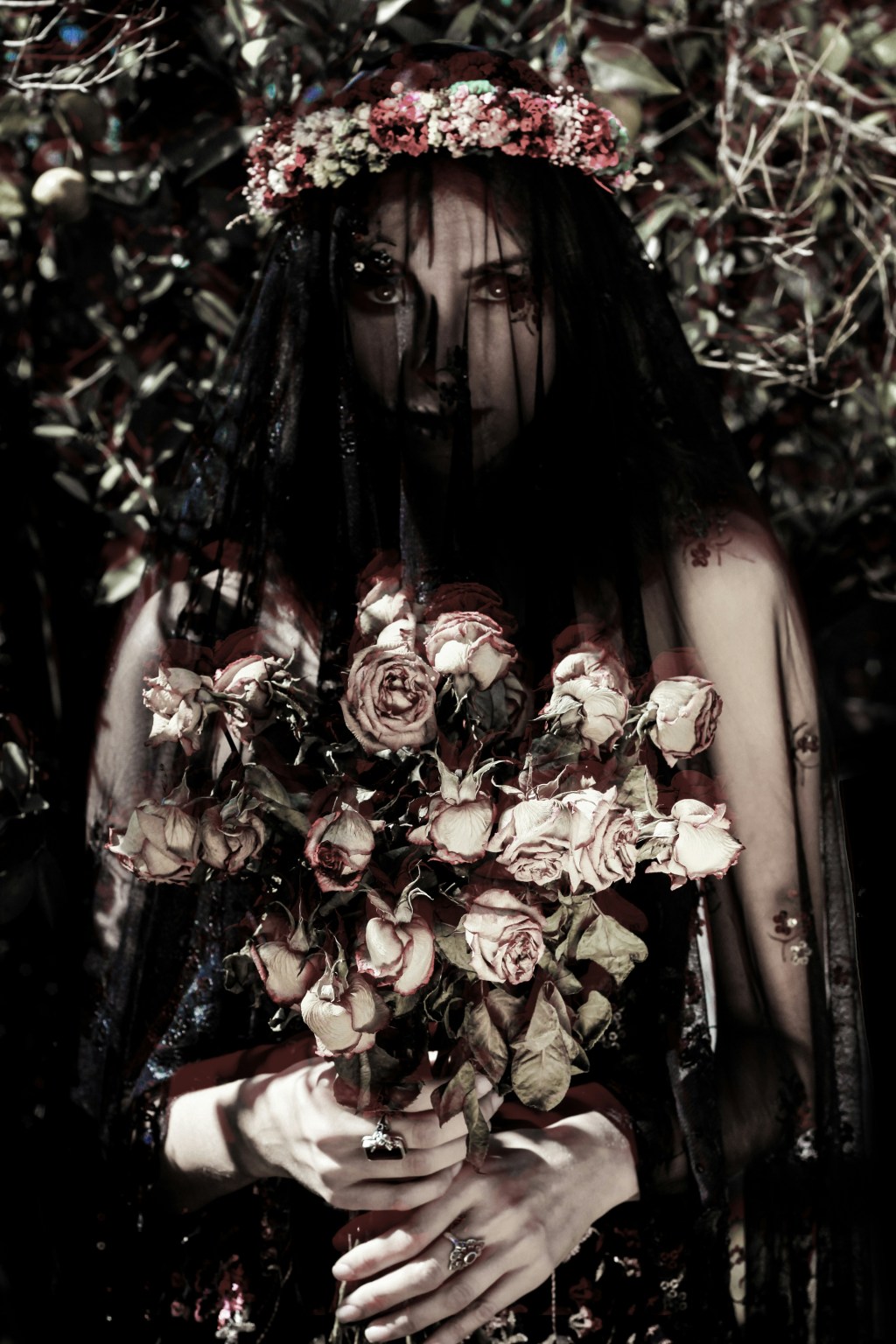

This week’s blog comes a day early to celebrate Día de los Muertos – the Mexican Day of the Dead!
Today’s post is a short story I wrote a few years ago that’s never before appeared on this site. I’m thrilled to finally share it with you.
‘Catina’ is one of thirty stories from my collection The Front Step — a book full of life, loss and laughter, plus all the absurdity and strange beauty found in everything between.
Have a read, and if it stirs something in you (or even just makes you smile), drop a comment below — I’d love to hear your thoughts, or even better, why not purchase a copy of The Front Step? I’m sure you’ll love it!
Catrina
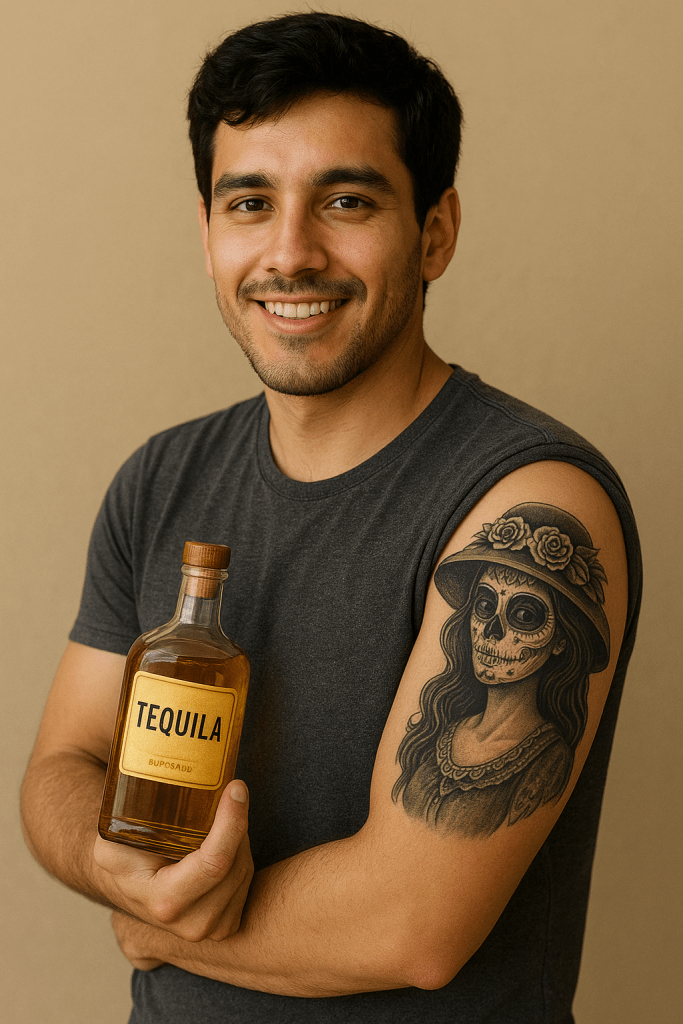
She’d attached herself to my arm a year ago.
Everywhere I go, Catrina goes too.
“Darren, I don’t like her; get rid of her,” my mother says. “I brought you up to be better than that.”
While my friends haven’t said it, I think they’re jealous. “Jeez, mate,” they say, “she’s a stunner. Can’t believe you’d get one as nice as that.”
And, as much as she loves to hang onto my arm, I’m equally captivated by her. She’s really gotten under my skin. With dark sunken eyes and puckered pouty lips, she’s got a face that captures my soul.
I know it sounds creepy, but I spend hours just watching her. Her all-knowing eyes staring back, promising way more than I have a right to expect.
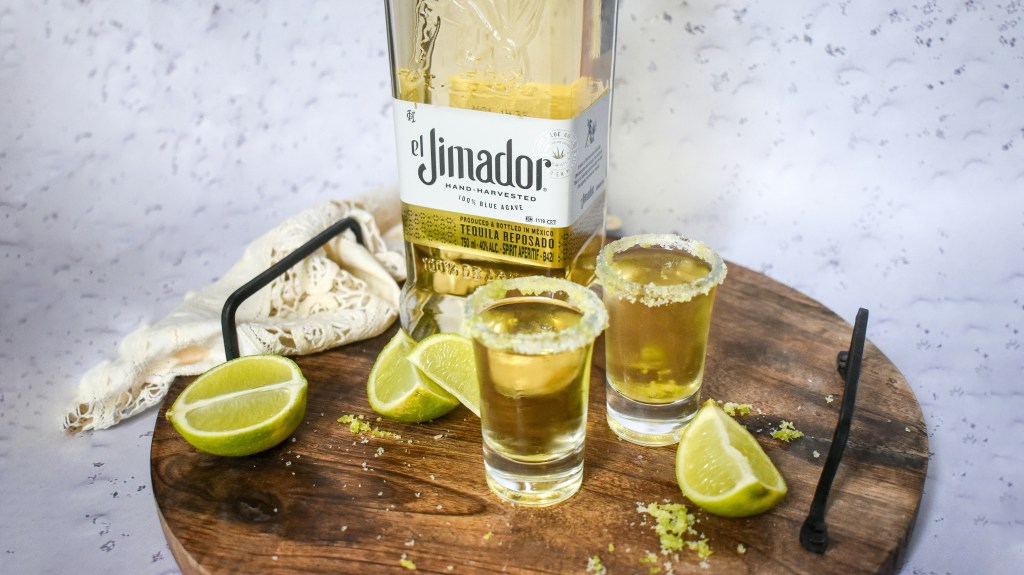
‘No salt or lemons!’
That’s how real men drink Tequila – at least, that’s what I imagine Catrina would say. How much Tequila is enough? Answer – you can never have enough.
You don’t need a reason or special occasion to drink Tequila. You just need an excuse—a lousy day, an argument, or just having too much time on your hands. Saturday is the sixth day of the week, and six is the first perfect number. So, Saturday is the perfect night to party. Like ink on the skin, and stories in a scar, it’s all connected.
A couple of mates came over; poker and nachos, Tequila; then four hours spinning yarns of deteriorating quality. I kicked them out just before the witching hour.
Naked, I retired to bed.
Moments later, just before I drifted off, a velvety voice rasped, “Muévete, guapo.”
Catrina had finally slipped off my arm and into my bed. She was telling me to move over.
She pressed her body hard against mine and whispered in my ear:
“How much do you want me?”
“This much,” I replied, moving her hand from my chest, dragging it lower.
Catrina giggled, “No tan rápido, amigo,” restoring her hand to my chest. “You have to earn it first.”
Locked in her loving spoon, overwhelmed by the redolence of gardenias and roses escaping from her floral headband. I brought her hand to my lips and kissed it, her skin tasting of chilli and cinnamon. If there was a waiting lounge in heaven, I was surely luxuriating in its splendour.
“You can have me,” she tempted, “only if you come home with me to meet my family.”
“Aren’t all of your family dea…?”
“Shush,” she interrupted, pressing her bony finger against my lips.
“You’ve never spoken of them before; that’s all.”
“Shush,” she said again, “¿Me quieres, o no?”
“Of course, I want you,” I cried, fearing I’d blown everything.
“Then close your eyes, hold my hand tight, and follow me.”
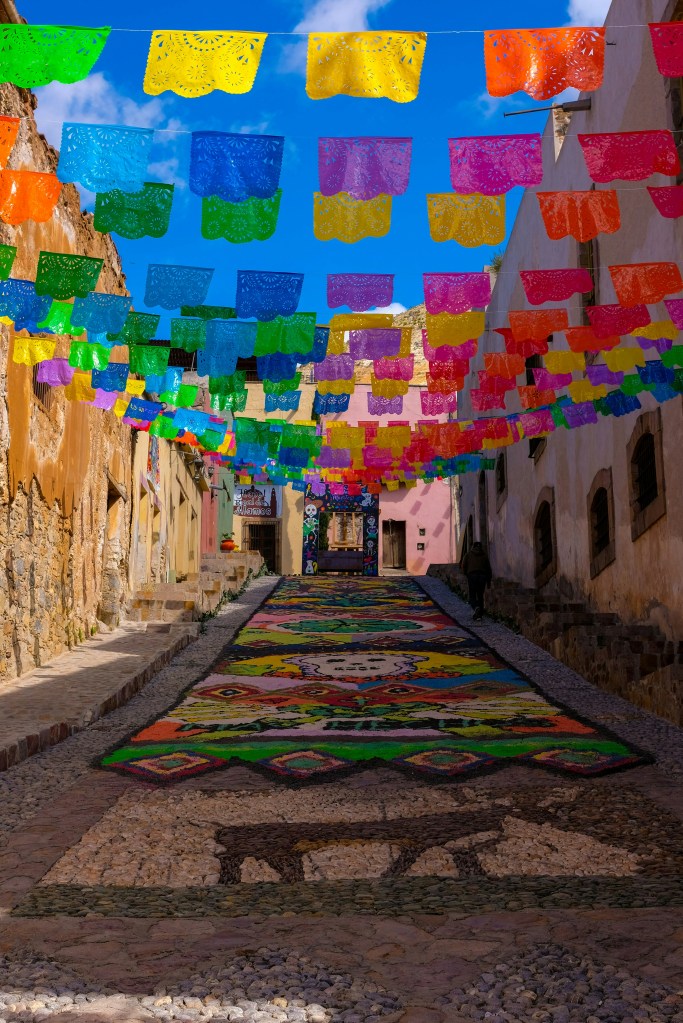


She led me out of my darkened bedroom into a fiesta of colour. I followed her through an explosion of stalls and people yelling, their noise trumpeting the sounds of commerce and connection. The smells of deep-fried pork and Tacos al Pastor danced in the air, tempting taste buds and teasing noses. The colours of life and the living blazed everywhere, overwhelming my sallow, empty eyes.
“Where are we?” I yelled.
Catrina turned and smiled. “My hometown, Puebla.”
She skipped on, mercurial as a jarabe dancer.
“Where are we going?”
“To the Zócalo – the Plaza!”
We walked, eventually entering a darkened corner of the city. Gone were the glorious pigments that had dressed the buildings surrounding the market. Plaster-like beige and drab, crumbly greys replaced the bright yellows, reds, blues, and greens. An obnoxious claw of burning rubber choked the air.
Rounding a corner, we encountered youths loitering around a trash can fire. They were burning a car tyre, the thick black smoke hanging low, threatening to sully their crisp white shirts.
“Cholos from the barrio.”
“What?”
“Gangsters from the hood, they call themselves ‘The Choir Boys.’ Let’s go – get out of here, vamos!”
She dragged me into the nearest alley; we sprinted away, abuse and jeers chasing our heels.
“We’ll be safe in here,” she assured, “I know this neighbourhood.”
Catrina navigated the maze of alleyways, right, right again, then left. The yells from behind, sounding sinister and closer. Visions of being mugged, beaten, or stabbed raced through my mind. As my fear grew, my legs slowed. Looking over my shoulder, the gang was now within thirty metres. I tried to swallow my panic.
Ahead of us, a group of barrel-chested men worked out on street gym equipment.
Catrina called, “Chica, Chica, ¿pueden ayudarnos?”
Smiling, she turned to me. “We’ll be safe now. I’ve asked my friend Chica to help us.”
A short, balding man in a singlet looked up and beckoned his friends. They stopped their bench pressing and dropped their dumbbells and bars, lining up in a protective semicircle that Catrina and I ran into.
The gang stopped, a real Mexican standoff! Chica’s friends snared, stared, and flexed their muscles. Then, without warning, they lumbered off, chasing the young pretenders away. One man stayed. I presumed he was Chica.
He bearhugged Catrina, then crushed my hand with his massive handshake.
“Hola,” he said with a big grin. I tried to smile but grimaced instead. My hand hurt so much.
Catrina and Chica spoke a language I didn’t understand—it wasn’t English or Spanish. Their arms began gesticulating. They laughed, their raised voices filling the air with animation and familiarity. They hugged again.
Catrina reached for my sore hand.
“Chica and I are old friends; his name is Chicahua, but everyone calls him Chica. Good news, he will take us to the Zócalo.”

Chica led us to his green VW Beetle. I climbed into the back. We took off, the beetle screaming disapproval, the car struggling to gain momentum, and me struggling to see past Chica’s massive shoulders.
“Chica’s friends are from Ecuador,” Catrina said from the front. “They sell black market cigarettes, rip-off bags and CDs.”
“Sí,” I replied, feeling jealous, using my best Spanish, “¡Esta es la vida! Mi amigo.”
Chica looked in the rear-view mirror and chuckled. Catrina looked back and winked.
The Zócalo was deserted. I was disappointed. I was expecting dancing, big-breasted prostitutas, mariachi bands and canteens selling corona, margaritas and mezcal. Instead, it was a dull, blank space in the quiet city centre. Catrina took off, heading toward a brown baroque building adjoining the Zócalo. I moved to follow, but Chica grabbed my sore hand, stopping me. I yelped.
“No, wait, Kiwi,” he said in broken English. “Catrina, be back. She prays at altar of Cathedral. She will return. Wait.”
Catrina furtively entered the brown building while Chica and I sat by an unimaginative fountain.
He offered me a cigarette. “American,” he said, “good.”
I shook my head, then looked up. It was a full moon, clouds raced across the sky, the stars playing peek-a-boo behind them.
“We go to cemetery next,” Chica said, “pay respects, celebrate.”
“To whom? With whom?” I asked.
He looked at me funny. “Dead people!”
“Oh, of course,” I said, confused.
“Sí, Catrina should also be resting with them.”’
“What do you mean?”
Chica offered another cigarette. “You might need this, Kiwi.”
I shook my head. I hadn’t smoked in years. I was tempted. Death gave me the heebie-jeebies.
We sat in silence. Chica smoked his cigarette, then threw the butt to the ground.
“What do you know of Catrina?” he asked.
“Not much, although my skin tingled when I first saw her. I felt an indescribable energy flowing through my veins. Then, something strange happened when she looked at me with her dark eyes. It was a feeling unlike anything I’d ever felt before. I closed my eyes, but her image was permanently etched. I put it down to love. Love at first sight.
“She didn’t speak, but her message was as loud and clear as the cathedral bells. ‘I have been waiting for you for a long time. Thank you; you are the one who will bring me to life. I have been waiting too long.’”
Chica nodded, looking at me seriously. “You know nothing, he said dismissively.”
“I guess not,” I said, starting to feel uneasy, wondering if I should smoke after all.
“I will tell you but forgive my bad English.
“A long time ago,” Chica started. “Before Spaniards came, before Cortés, Aztecs lived in Mexico and thrived. For three hundred years, their culture …, how you say? Shone as bright any stars in night. Jealousy of their wealth and culture spread. Aztecs had many enemies.
“One day, enemies of Aztecs united with Cortés and slayed Aztecs with swords and disease. Catrina was a young woman with a girl baby when Spaniards came. Her husband and other young men were killed or taken away as a slaves. Young women kept as prizes for soldiers. Older women and children killed dead. Catrina prayed to Mictēcacihuātl, the goddess of death. She prayed for her baby be saved from execution, that she be killed instead. Mictēcacihuātl looked down in pity. She cried, as she herself was sacrificed as a baby. She spared Catrina’s baby in exchange for Catrina’s life.
“Seeing her people dead, Mictēcacihuātl became angry. She knows that she and her husband, Mictlāntēcutli, would soon die the slow, insidious…, is this right word? death of forgotten deities. New kid on town, Jesus Christ, would replace them. She said to her husband, ’I must do something. You must do something.’
“Mictēcacihuātl told Catrina that if she could find a man willing to believe and mark her life, she would be permitted to return to living realm one day a year. She can return to life for 24 hours to celebrate and remember those who have passed, Día de los Muertos!, The Day of the Dead! Catrina would be Mictēcacihuātl’s replacement. She is now the queen of memories, celebrating the lives of all those who lived.”
I sat in silence, trying to understand what I’d been told. After a minute, I asked, “So, why did Catrina enter the Cathedral?”
Chica smiled. “Because the Spaniards raised her baby daughter, she became a Catholic. She prays for her baby’s soul to the Catholic God. The Church thinks Catrina is unholy and tries to stop her from entering. They send out their Choir Boys to frighten her away.”


“How do you know these things?” I asked.
“Because I was her husband.”
When Catrina returned, we climbed back into Chica’s beetle. It was humid. I was tired. On the way to the cemetery, I quickly succumbed to the gentle bumps and intoxicating fumes from the engine behind me.
I woke. It was morning, and I was back in my room. My head ached, my hand was numb, and Catrina was no longer in my bed or on my arm. Mother would be pleased. I got up and stood in front of the mirror, naked now, in every sense. The best part of me was gone.
I decided to go out. I needed bread and milk, and I craved grease and caffeine. I’d only walked two blocks when I heard people singing, backed by what sounded like a mariachi band. It was a parade. I crossed the street and then turned the corner to see what was happening.
Down the road, I saw a comparsa of well-dressed skeletons. They zigged and zagged ghoul-like from footpath to footpath, handing out what must have been sweets to children. In the middle of the road, women with brightly coloured flouncy skirts danced energetically. Suited and booted men held long poles topped with skulls, flags, and bunting—the poles waving in time to an unseen drummer’s beat. Everyone was grinning, their joy infectious.
“What’s going on?” I asked a woman.
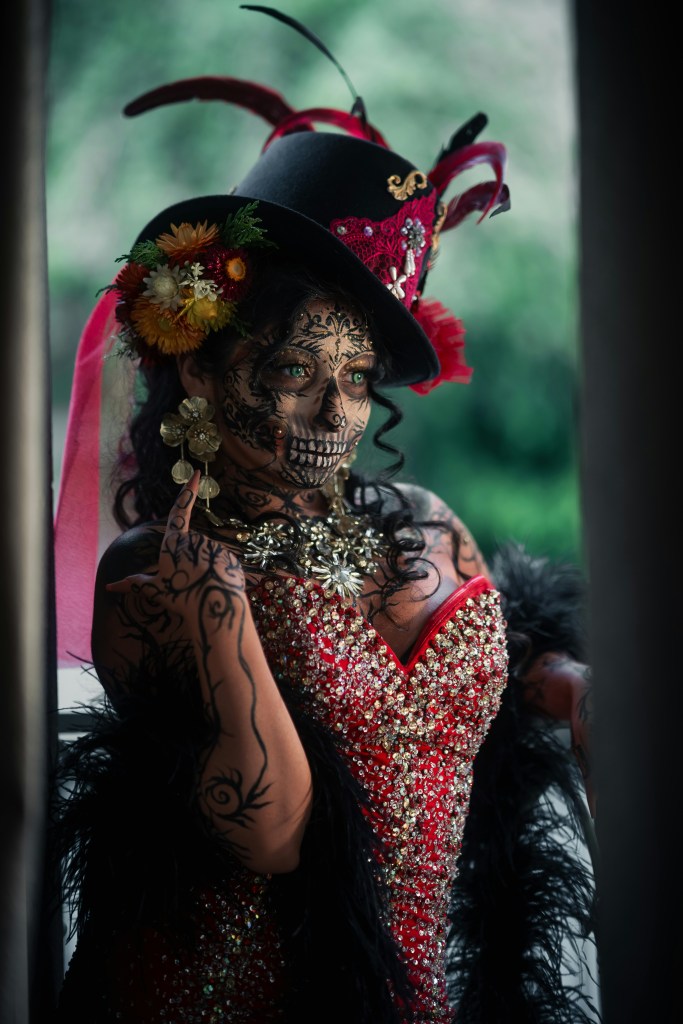
“Today is November the 1st,” she answered, “the Day of the Dead – Día de los Muertos! See the lady leading the parade?” She pointed. “She’s La Calavera Catrina!”
“Catrina?”
I studied the leader closely. It was my Catrina!
The parade approached; I called out.
Catrina ran over, kissed my cheek, and whispered in my ear:
“Do not fear, guapo; I will return to your bed tonight and afterwards return to your arm. You will always be mine, and I will always be your loving tattoo.”
I slowly wandered off, thinking I might buy some cigarettes as well.

 Roly Andrews Storyteller